


Gauge, blend ratio, and fabric weight are the three numbers that decide whether a knitted garment behaves the way a buyer expects. They are also the three numbers most often confused in purchase orders. This guide explains what each one actually controls, how they interact, and how to write a specification that a knitting mill can quote against without guessing.
What Knitting Gauge Actually Measures
Gauge is the number of needles per inch on the knitting machine bed. A 16-gauge (16G) flat knitting machine has sixteen needles in every inch of its needle bed. A 12-gauge machine has twelve. This single number sets the finest yarn the machine can handle and the tightest loop it can form.
The practical consequence is counterintuitive to many buyers: a higher gauge number produces a thinner, finer, more delicate fabric — not a heavier one. A 16G sweater is made from finer yarn at a denser stitch count than a 12G sweater of the same dimensions, and it will feel smoother and drape more fluidly. Our own production uses 16-gauge imported Stoll machines for fine-gauge base tops and jacquard cardigans, and 12-gauge Stoll machines where a heavier, more substantial hand-feel is required.
Machine brand matters for a different reason. Stoll flat-bed machines hold tension more consistently across a panel, which reduces stitch irregularity at the selvedges. When a buyer is comparing quotations from two mills at the same nominal gauge, asking which machine model produced the sample is a legitimate and often revealing question.

Reading a Wool Blend Ratio Correctly
A blend percentage tells you three things at once: the fibre cost, the performance envelope, and the likely care requirements. The table below maps the blend structures present in our own product range against the buyer outcome each one targets.
| Blend structure | Composition | What it buys the buyer | What to watch |
|---|---|---|---|
| Pure wool | 100% wool | Maximum warmth-to-weight ratio, natural temperature regulation, clean hand-feel | Higher unit cost; requires careful wash instructions |
| Pure ultra-fine merino | 100% Australian 100-count ultra-fine merino | Fine-gauge softness with no prickle, suitable for next-to-skin base layers | Fibre sourcing must be documented; premium price band |
| Cashmere blend | 30% cashmere / 70% wool | Luxury hand-feel and softness at materially lower cost than pure cashmere | Cashmere content is the cost driver — verify by test report |
| Wool-rich performance blend | 32.8% wool / 44.2% polyester / 23% acrylic | Anti-pilling and anti-fading performance, dimensional stability, lower care burden | Synthetic share reduces the wool hand-feel; specify it deliberately |
The wool-rich performance blend deserves a closer look because it is the structure most often misjudged. Adding polyester and acrylic is not a cost shortcut in every case. Polyester contributes dimensional stability and abrasion resistance; acrylic contributes bulk and colour retention. In our 16-gauge jacquard cardigans and lace-trim base tops, this exact 32.8 / 44.2 / 23 structure is specified specifically to deliver anti-pilling and fade-resistant performance across repeated wear cycles — a specification, not a compromise.
Fabric Weight and Why 16G Is Not a Weight
Fabric weight in grams describes the finished garment mass and drives warmth, layering position, and shipping cost. It is independent of gauge. Our fine-gauge base tops span 200g to 320g while sharing the same 16-gauge construction family, which demonstrates the point plainly:
- 200g — lightweight, intended for indoor wear or as a true layering piece under coats and blazers
- 230g — the balance point for a mock neck base top: warm enough for cold seasons while staying light against the body
- 240g — a jacquard cardigan that reads as lightweight yet warm, positioned for indoor wear or layering
- 320g — a thick, substantial piece where warmth leads and layering is optional
A common error in incoming purchase orders is reading the "16G" in a product title as a weight or a yarn count. It is neither. Gauge and weight must be written as two separate specification lines, and a well-formed order states both plus the target garment size at which the weight was measured.
Fibre Sourcing: Merino and Mohair
Two fibre families in our range carry sourcing claims that buyers should verify rather than assume.
Merino wool is graded by fibre diameter, and "ultra-fine" and "100-count" are claims about that diameter. Fine Australian merino is used where the garment will sit against skin: our mock neck base tops are knitted from 100% high-grade Australian 100-count ultra-fine merino on 16-gauge German Stoll machines. The fine-gauge construction and the fine fibre reinforce each other — a coarse fibre on a 16-gauge machine would waste the machine's capability.
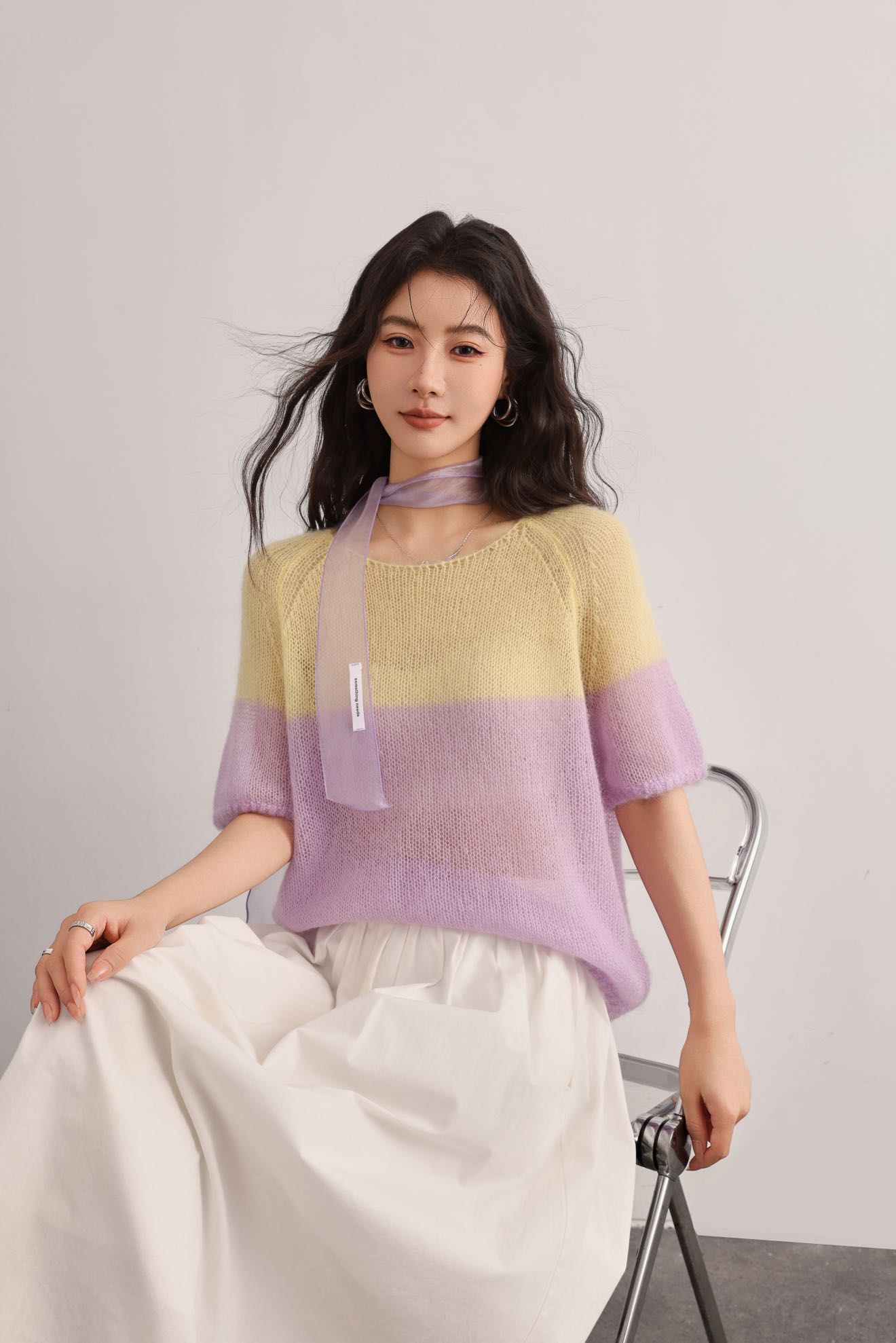
Mohair behaves differently from wool. It has a natural lustre and a hollow, airy structure that produces a fluffy, cloud-like surface with excellent warmth at low weight. It is a styling fibre as much as a performance fibre, and it is typically blended or used in half-sleeve and layering pieces rather than in next-to-skin base layers.
Writing the Specification So It Can Be Quoted
The gaps that cause disputes after bulk production are almost always information the buyer held but never wrote down. A knitting specification that a mill can quote against should carry all of the following as explicit fields:
- Gauge and machine class — state the gauge number and whether a specific machine family is required, and require the machine model to be confirmed on the sample
- Blend ratio with a tolerance — exact percentages plus an acceptable variation band, and a fibre-content test report for cashmere or merino claims
- Fabric weight with the measurement size — a gram figure is meaningless without stating which size was weighed
- Performance requirements stated as tests — anti-pilling and colour-fastness should be named as the standard to be met, not as adjectives
- Colourways with a reference — pantone or a physical swatch, plus the number of colourways to be produced
- Construction details that affect cost — neckline type, placket, trim, detachable components, and any jacquard or intarsia patterning
Puyuan in Tongxiang, Jiaxing is the core knitwear production cluster in China, and most mills there work from specifications of exactly this kind. The cost of writing six clear lines is measured in minutes; the cost of resolving a gauge, blend, or weight misunderstanding after bulk production is measured in weeks and in rejected goods.